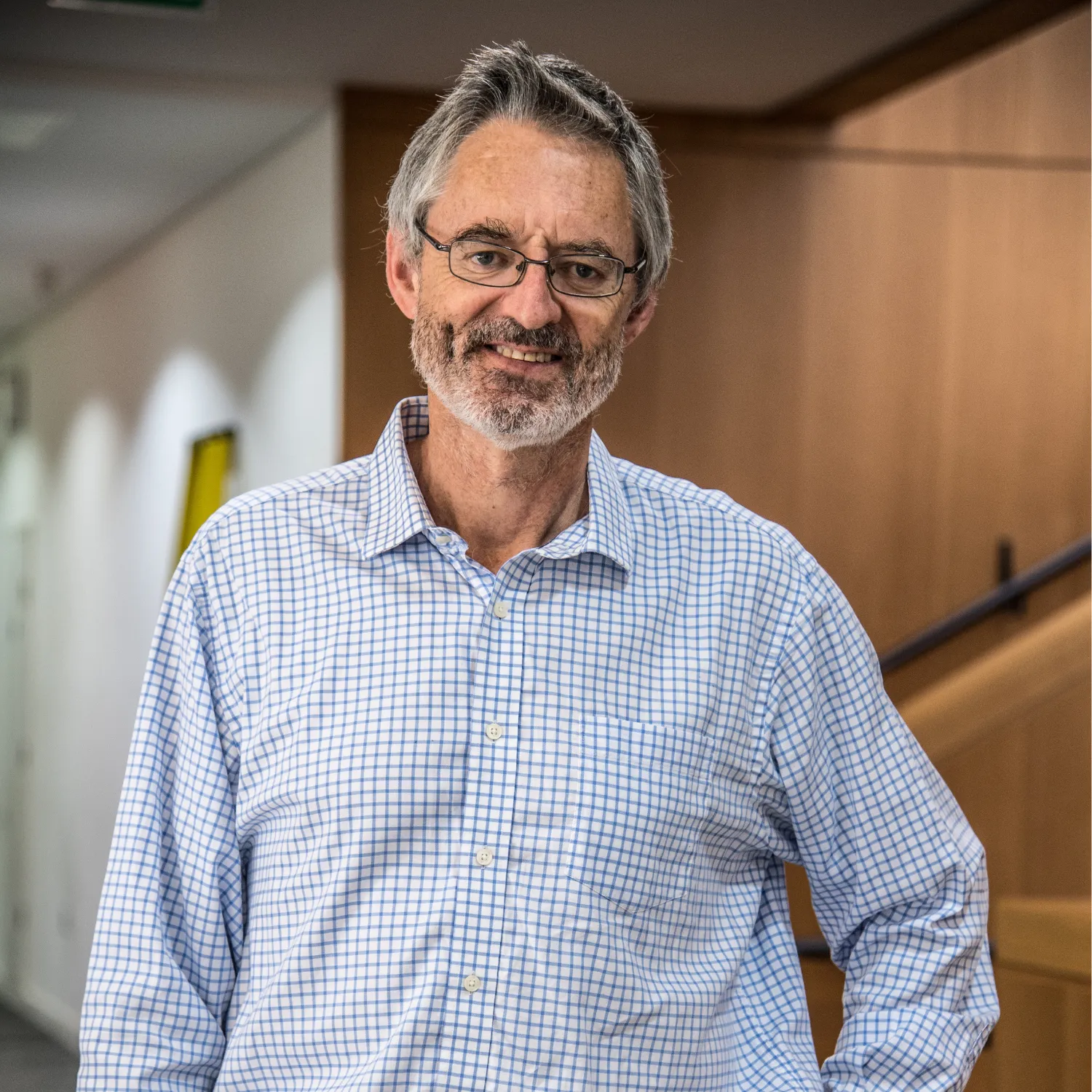
A St John’s professor who helped Cambridge hospitals respond to Covid and led the logistics for a programme testing up to 10,000 students a week during the peak of the pandemic has been elected a Fellow of the Royal Academy of Engineering.
Professor Duncan McFarlane, Professor of Industrial Information Engineering at the University of Cambridge and a Fellow and College Lecturer in Engineering at St John’s College, is one of 75 people elected to the Fellowship in 2026.
Professor McFarlane said: “I am really honoured to have been elected a Fellow of the Royal Academy of Engineering, and particularly excited to be joining the Fellowship during the Academy's 50th anniversary year.”
The Royal Academy brings together more than 1,700 leading figures in technology, business and academia. This year’s intake includes a record 24 women, with new Fellows working across fields including artificial intelligence, clean energy, medicine and public health.
The new Fellows join in the Academy’s 50th anniversary year. It was founded as the Fellowship of Engineering in 1976, when 130 of the UK’s leading figures in the profession met at Buckingham Palace with the backing of Prince Philip, Duke of Edinburgh.
Among those founding Fellows was St John’s computer scientist Sir Maurice Wilkes, who helped set up Cambridge’s Computer Laboratory and designed EDSAC, the world’s first programmable computer.
Sir John Lazar CBE FREng, President of the Royal Academy of Engineering, said: “As we celebrate our 50th anniversary this year, we also mark the Academy’s achievements since it was founded as the Fellowship of Engineering on 11 June 1976 at Buckingham Palace, with the enthusiastic backing of HRH The Prince Philip, Duke of Edinburgh, our Founding Senior Fellow.
“Our Fellowship has been at the core of our work for the past 50 years, connecting the business leaders, entrepreneurs, researchers and policymakers who are at the heart of the UK’s technological progress.
“This year’s cohort will be joining a community of over 1,700 top engineers and innovators in the UK and around the world. Together, we ensure that bright ideas are supported, scaled and shared, turning ambition into innovation and innovation into impact. We aim to strengthen education, skills and inclusion to inspire and equip the engineers of today and tomorrow.”
“I am so very pleased to become part of the Royal Academy of Engineering and its work in creating a better world”
Professor McFarlane joined Cambridge’s Department of Engineering in 1995 and has been Professor of Industrial Information Engineering since 2011. He heads the Distributed Information & Automation Laboratory at the Institute for Manufacturing.
His research covers industrial automation, digital technology, supply chains and logistics, with work put into practice by companies including Boeing, Unilever, Foxconn and Siemens. He led the Boeing-Cambridge research partnership from 2017 to 2022.
He also developed Digital Manufacturing on a Shoestring, which uses low-cost, readily available technology to help small and medium-sized manufacturers introduce digital systems without the expense and complexity of conventional solutions. Shoestring technologies have been implemented more than 350 times.
When Covid struck, Professor McFarlane led a Cambridge team working with local hospitals on their rapid response to the pandemic.
At Addenbrooke’s, his team used techniques developed for industry to model patient flows, waiting times and demand for beds, staff and equipment. Their work also covered oxygen supplies, Covid testing and the sourcing and storage of PPE.
Professor McFarlane went on to become logistics lead for the University’s asymptomatic student screening programme, set up in just eight weeks to identify Covid infections among students who had no symptoms.
His team established a mini-factory to assemble test kits and organised their distribution to, and collection from, Colleges across Cambridge. At its peak, the programme was testing around 10,000 students every week.
His work supporting hospitals during the pandemic was previously recognised by the Royal Academy of Engineering with a President’s Special Award for Pandemic Service.
The 75 new Fellows will be formally admitted to the Academy at a ceremony in London on 19 October, when they will sign the roll book.
Professor McFarlane said he was grateful for the support he had received over many years from colleagues, staff and students in the Department of Engineering and at St John’s, as well as from his industrial and academic collaborators.
He added: “The Royal Academy of Engineering is an extraordinary community of engineers and innovators and I am so very pleased to become part of the Academy and its work in creating a better world.”