The researchers, led by Professor Erwin Reisner, a Fellow of St John’s College, say their solar-powered reactor could be used to make fuel to power cars and planes, or the many chemicals and pharmaceuticals products we rely on. It could also be used to generate fuel in remote or off-grid locations.

Unlike most carbon capture technologies, the reactor does not require fossil-fuel-based power, or the transport and storage of carbon dioxide, but instead converts atmospheric CO2 into something useful using sunlight. The results are reported in the journal, Nature Energy.
Carbon Capture and Storage (CCS) has been touted as a possible solution to the climate crisis, and has recently received £22bn in funding from the UK government. However, CCS is energy-intensive and there are concerns about the long-term safety of storing pressurised CO2 deep underground, although safety studies are currently being carried out.
“Aside from the expense and the energy intensity, CCS provides an excuse to carry on burning fossil fuels, which is what caused the climate crisis in the first place,” said Professor Reisner, Professor of Energy and Sustainability at the University of Cambridge. “CCS is also a non-circular process, since the pressurised CO2 is, at best, stored underground indefinitely, where it’s of no use to anyone.”
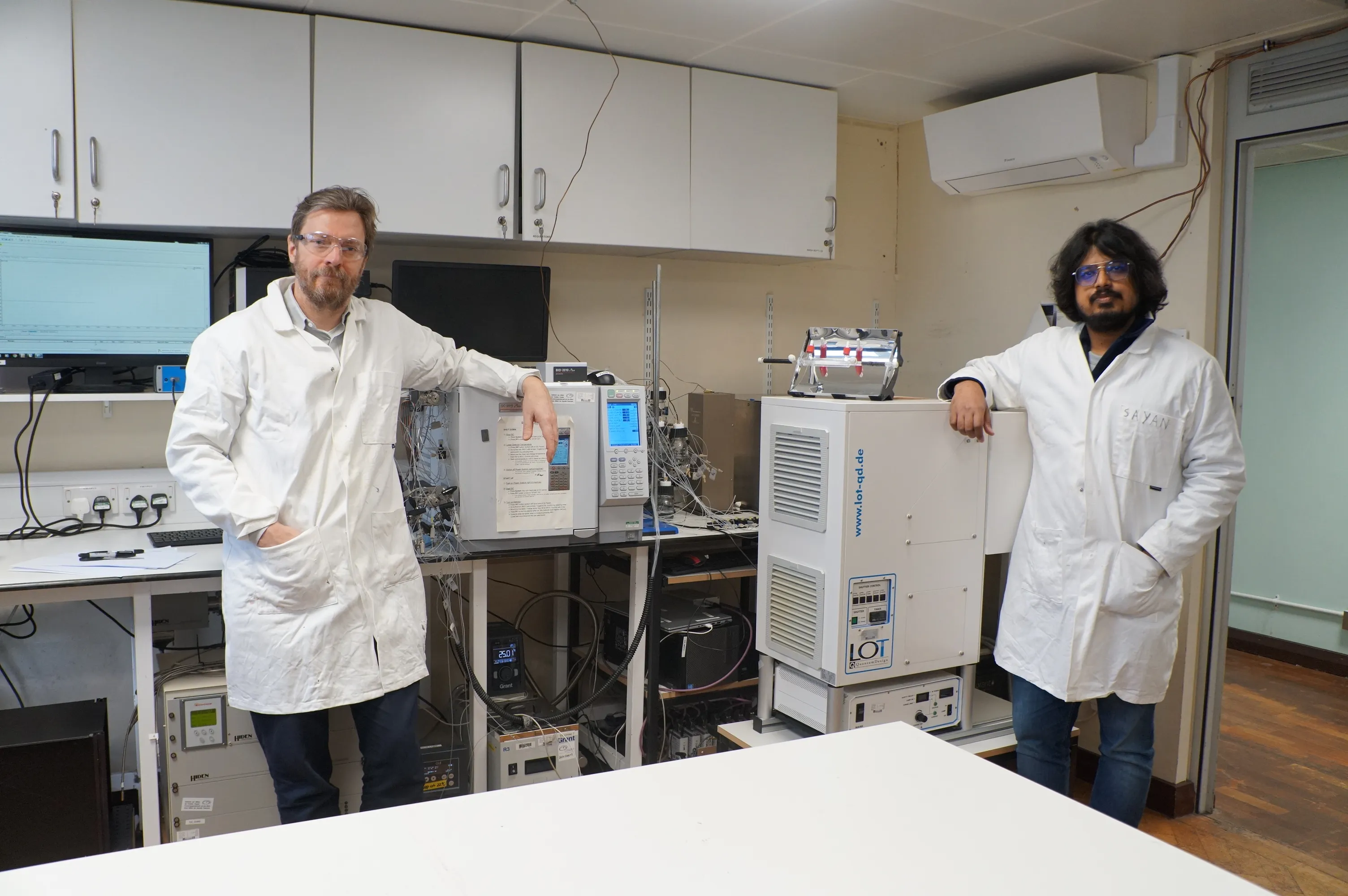
“What if instead of pumping the carbon dioxide underground, we made something useful from it?” said first author Dr Sayan Kar from Cambridge’s Yusuf Hamied Department of Chemistry. “CO2 is a harmful greenhouse gas, but it can also be turned into useful chemicals without contributing to global warming.”
The focus of Professor Reisner’s research group is the development of devices that convert waste, water and air into practical fuels and chemicals. These devices take their inspiration from photosynthesis: the process by which plants convert sunlight into food. The devices don’t use any outside power: no cables, no batteries – all they need is the power of the sun.
The team’s newest system takes CO2 directly from the air and converts it into syngas: a key intermediate in the production of many chemicals and pharmaceuticals. The researchers say their approach, which does not require any transportation or storage, is much easier to scale up than earlier solar-powered devices.
The device, a solar-powered flow reactor, uses specialised filters to grab CO2 from the air at night, like how a sponge soaks up water. When the sun comes out, the sunlight heats up the captured CO2, absorbing infrared radiation and a semiconductor powder absorbs the ultraviolet radiation to start a chemical reaction that converts the captured CO2 into solar syngas. A mirror on the reactor concentrates the sunlight, making the process more efficient.
The team is currently working on converting the solar syngas into liquid fuels, which could be used to power cars, planes and more – without adding more CO2 to the atmosphere.
“If we made these devices at scale, they could solve two problems at once: removing CO2 from the atmosphere and creating a clean alternative to fossil fuels,” said Dr Kar. “CO2 is seen as a harmful waste product, but it is also an opportunity.”
The team says that a particularly promising opportunity is in the chemical and pharmaceutical sector, where syngas can be converted into many of the products we rely on every day, without contributing to climate change. It is building a larger scale version of the reactor and hope to begin tests in the spring.
If scaled up, the researchers say their reactor could be used in a decentralised way, so that individuals could theoretically generate their own fuel, which would be useful in remote or off-grid locations.
“Instead of continuing to dig up and burn fossil fuels to produce the products we have come to rely on, we can get all the CO2 we need directly from the air and reuse it,” said Professor Reisner. “We can build a circular, sustainable economy – if we have the political will to do it.”
The technology is being commercialised with the support of Cambridge Enterprise, the University’s commercialisation arm. The research was supported in part by UK Research and Innovation (UKRI), the European Research Council, the Royal Academy of Engineering, and the Cambridge Trust.
Reference:
Sayan Kar et al. ‘Direct air capture of CO2 for solar fuels production in flow.’ Nature Energy (2025). DOI: 10.1038/s41560-025-01714-y