A major new study is making the case for the recognition of one of Europe’s most audacious literary voices.
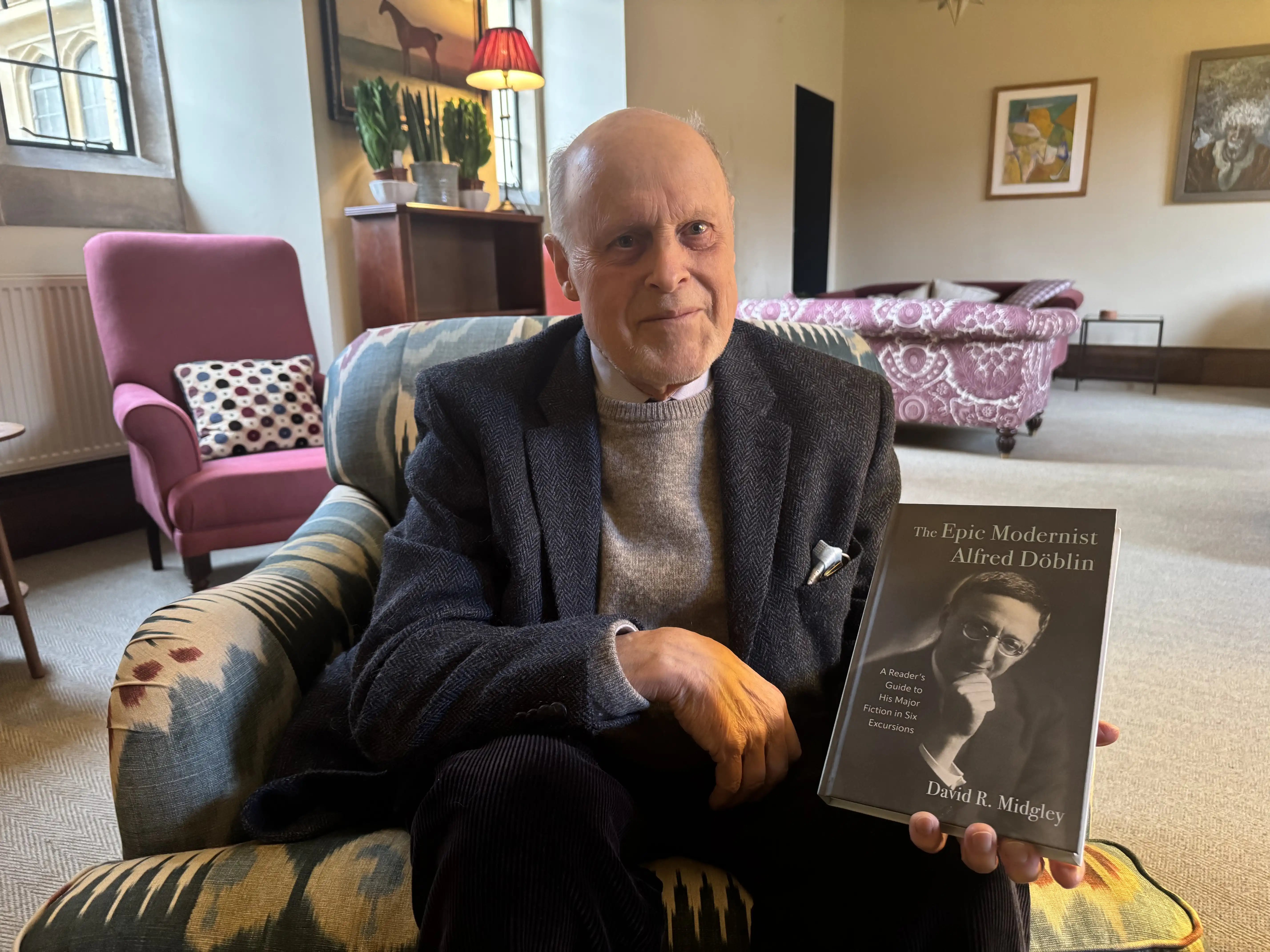
In The Epic Modernist: Alfred Döblin, published by Camden House, a subsidiary of Boydell & Brewer, Professor David R Midgley, St John’s Fellow, sets out to reposition Alfred Döblin not as the author of a single famous novel, but as a writer of epic scale, formal daring and historical reach.
Döblin is still best known, where he is known at all, for Berlin Alexanderplatz, his electric portrait of Weimar Berlin. But Döblin wasn’t a writer with one masterpiece, he created around a dozen substantial, serious works, spanning history, myth, politics, exile, and modern life.
Professor Midgley explained: “Some are clearly historical, some take you through contemporary situations, others move into the realm of myth. Döblin covers the ground from antiquity to the modern world, from the European conquest of the Americas to family life in England after the Second World War. When people only know Berlin Alexanderplatz, they miss the fact that he was constantly changing scale and subject.”
The problem, he suggests, is visibility. “He’s certainly not well known in the English-speaking world, although most of his works are available in English translation, and that was part of the motivation – to provide a book in English that would help people understand this author and the range of his writing.” In many surveys of the modern novel, he adds, “you’re lucky if you get a paragraph about him”.
“There’s a deep-rooted scepticism about using language in a way that labels and pins things down”
Midgley’s book is designed as an answer to that neglect. Rather than march through Döblin’s career year by year, he organises the study thematically – “person”, “power”, “nature”, “culture”, before turning to “styles and techniques” and finally “ideas and beliefs”.
The aim, he says, is clarity without simplification: “The book is written to be accessible to everyone, while still including the detail and references that scholars expect,” he says. Readers are encouraged to dip in and out, finding their own way through an unusually wide-ranging body of work.
Professor Midgley is Emeritus Professor of German Literature and Intellectual History, Faculty of Modern and Medieval Languages and Linguistics. Throughout his long academic career in Cambridge, he taught a wide range of topics in German literature, history and thought, as well as giving regular classes in German language. He directed studies in Modern & Medieval Languages at St John’s for many years.

He has published a wide range of articles on German literature and intellectual history. In 2000 his book Writing Weimar, a comprehensive study of the literature of the Weimar Republic, was published and in 2012 he received acclaim for his long article on the reception of the philosopher Henri Bergson in the German speaking world. He has been working on his newly published analysis of Döblin since he retired in 2015.
Midgley says Döblin was highly aware of how he was telling his stories. He compares the writer to a sculptor choosing “the right weight of hammer” for each task – selecting his storytelling techniques with care. The novels show events vividly but rarely offer simple moral judgements. Characters’ motives are often unclear, and even language itself is treated cautiously. As Midgley puts it, “there’s a deep-rooted scepticism about using language in a way that labels and pins things down”.
“He clearly convinced himself that history wasn’t simply moving in one direction with things getting better all the time”
That scepticism was forged in turbulent times. Born into a Jewish family in the late 19th century, Döblin fled Germany in 1933 after heeding urgent warnings in the wake of the Reichstag fire. Exile took him through Switzerland and France to the United States, before a post-war return to Europe. Violence, guilt and upheaval run through his fiction but not for effect. “It’s not done either to shock or for cheap thrills,” Midgley says. “It’s part of the whole complex of human life and human interaction.”
Running through the novels, too, is a bleakly clear-eyed view of progress, or the lack of it. Döblin, Midgley argues, understood that history could turn back on itself. “He clearly convinced himself that history wasn’t simply moving in one direction with things getting better all the time. He determined that life is not like that." It is a judgement, he adds, that resonates far beyond the 20th century.
For Midgley the book marks the culmination of decades of engagement with a writer who has never stopped surprising him. “Whichever work I go to, I know there’s going to be something exciting,” he says. But he sees the study not as a last word, rather as a guide. “If you want to know more about this man, start here or there… follow the leads I give you, and then follow your nose.”
If he succeeds, The Epic Modernist may do more than reassess a single author. It may expand the map of modernism itself and bring a long-overlooked giant back into view.