PSALTERIUM TRIPLEX (RHEIMS?)
Vellum, 10 x 6.875, ff. 214 + 1, double and triple columns of 32 lines.
Early 12th cent., very finely written.
Donor, T. C. S. 2 fo. ut quicquid.
Old binding, skin over boards, clasp and 2 bosses gone. On 2nd cover,
Psalterium tripartitum (xiv) and trace of a label.
Collation: 18 - 38 46 58 - 278, one flyleaf.
Contents:
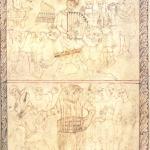
On f. 1a is a full-page drawing, which will be described later.
On f. 1b a very neatly-written title of the 16th cent.
Preliminary matter to the Psalter.
De dictis beati Hieronimi presbyteri ita excerptum est . . . . 2
(Title, as throughout, in red rustic capitals.)
Qui psalmi proprie ad singulos dies feriatos domini saluatoris nostri
filii dei pertineant sequestratim exposuimus
-oratio ante altare. xxxiii. Benedicam dominum in omni
tempore.
Item qui supra . . . . . . . . . . 2b
Psalterium inquirendum est in cuius lingua dicitur. Floril.
Casin. I 215.
-hebrei illum psalmum addunt de quo dicitur. Pusillus eram
inter fratres meos et adolescentior.
Inc. ex dictis origenis . . . . . . . . . 3b
Psalterium ita est quasi magna domus. xxvi 1277, Anecd.
Mareds. 3, II 1.
-primus psalmus est qui ita inc. Beatus uir.
Inc. Epistola Hieronimi ad Marcellam de diapsalmate . . . 3b
Quae acceperis reddenda. XXII 433.
-scientiam nescientum.
Origo prophetiae David regis psalmorum numero cl. . . . 4b
David filius Iesse cum esset in regno. XCIII 477.
-quia dauid dictus est christus.
Item unde supra Hieronimi . . . . . . . . 5
Psalterium Romae dudum positus. XXIX 117, etc.
-de purissimo fonte potare.
In Christi nomine inc. Ep. papae Damasi ad Hieron. presb. . . 5b
Damasus ep. fratri.
-per bonifacium presb. hierosolimam.
Item S. Hieronimi ad Damasum . . . . . . . 5b
Beatissimo pape Damaso
-latine prefatio.
Item alia epistola unde supra . . . . . . . . . 6
Nunc autem exposuimus originem
-qui sic habet. omnis spiritus laudet dominum
Item unde supra Damasi et Hieronimi . . . . . . . 6b
Psallere qui docuit dulci modulamine sanctos (smaller script).
Floril. Casin. I 213.
-monstrare triumphos.
Hieronimus ad Marcellam . . . . . . . . . 6b
Nudius tertius cum centesimum octauum decimum. CXXXI 145.
-sub pedibus nostris uelociter.
Item de libro S. Ysidori . . . . . . . . . 8
Liber psalmorum quanquam uno
-preordinauit ut uoluit.
S. Augustinus dixit . . . . . . . . . 8
Canticum psalmorum animas decorat. CXXXI 142.
-id caelo mirificabit in sec. sec. Amen.
No title . . . . . . . . . . . 8b
Verbum sela lxx interpretes
-rupta continuatio.
Quid sit psalterium uel psalmi quare dicantur. Psalterium est ut
Hieronimus ait.
-delectabili collatione restituunt. XCIII 1099, CXLII 44.
De prophetia. Prophetia est aspiratio diuina . . . . . . . 10
After this the sections are numbered (ii to xvi). The last is
De propria eloquentia psalterii : Primum est quod ipsi tantum psalmi
-inde legendi faciunt decenter initium.
Inc. Ep. S. Hieronimi ad Sunniam et Fretelam de psalterio quae de
lxx interpretum editione corrupta sint.
Dilectissimis fratribus.
The Greek is very correctly written, on the whole, in capitals.
-dolatorium dici potest. Expl. Ep. S. Hier. ad Sunniam et
Fretelam.
No title (Prologue to the Apocalypse).
Quoniam suscepti operis plenitudo . . . . . . . . 28
-exhibuisse seruitutis.
Inc. Prefatio . . . . . . . . . . . . 30
Eusebius Hieronimus Sofronio suo salutem dicit.
Scio quosdam putare psalterium in quinque libros. XXVIII 1183.
-cupio te meminisse mei.
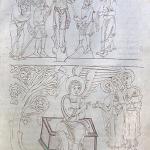
On f. 31a a full-page drawing.
The text of the Psalter in three versions, each in a single column,
Gallicum, Romanum, Hebreum . . . . . . . . . 31b
Titles of the Psalms in red rustic capitals.
Ending with Ps. cli (Pusillus eram), also in three versions, which
are absolutely identical save for these differences:
Verse 3. Gall. ipse omnium exauditor. Rom. ipse exauditor
omnium. Heb. ipse omnium exaudiet.
v.6 Gall. maledixit me. Rom., Heb. maled. michi.
7. Gall., Rom. ab eo ipsius gladio. Heb. ab ipso gladio.
The Cantica follow in two versions only (Gall., Rom.) the 3rd
column remaining blank . . . . . . . . . . 195
After Nunc Dimittis (f. 208a) is a change of hand and ink. The
rest is in double columns and contains Gloria in excelsis,
Te Deum, Pater noster, Apostles' and Nicene Creeds, Quicunque
vult, Letania (f. 210).
The 27th and last of the short prayers ending the Litany is
Angelum tuum sanctum domine.
Then follow:
Item oratio generalis. Pietate tua quesumus domine nostrorum solue . . . 214
Or. ad Sanctam dei genitricem. Singularis meriti sola sine exemplo . . . 214b
Ending imperfectly: cuidam tuo seruulo agenti in extremis.
The flyleaf blank but for a 16th cent. scribble: 'Rygth trusti and wellbelouid.'
The Litany contains:
Martyrs: NICHASI cum sociis tuis (sixth in order), Preiecte, Leodegari,
Lamberte, Candide, Utte (Vite), Genesi, QVINTINE, Luciane, Crispine, Cris-
piniane, Gentiane, Fusciane, Victorice, Priuate, Adriane, Symphoriane, TIMOTHEE, Maure cum sociis, Firmine, Gereon cum soc., Innocens, ending with Albane, Oricole, Eadmunde.
Confessors: REMIGI (4th), MARTINE, Sulpici, Aniane, Amande, Vedaste, NICHOLAE, Juliane, Brici, Medarde, Gildarde, Maximine, Candide, Machari,
Audoene, Sixte, Sinici, Viuenti, Reole, Niuarde, Rigoberte, Memmi, Arnulfe, Lupe, Richari, Filiberte, Theoderice, Theodulfe, Basole, Celsine, Gibriane, Alexis, Augustine.
Virgins: Genouefa, Columba, Iuliana, Afra, Tecla, Theodosia, Susanna, Benedicta, Eutropia, Saturnina, Iulia, Radegundis, Aldegundis, Monegundis, Columba, Gertrudis, Rigtrudis, Brigida, Sollemnis, Macra, Oricola, Basilica.
Suffrage: Ut cunctam plebem S. MARIAE et S. REMIGII conseruare digneris.
The italicised Saints belong to the province of Rheims.
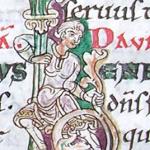
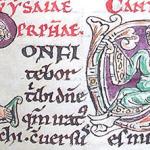
The decoration of the books consists of two full-page drawings in outline and a series of initials.
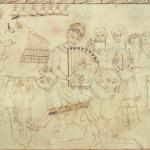
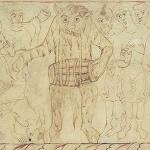
f. 1a. Full-page picture in two halves. Outline, heightened in places with red. It is enclosed in a frame of leaf-ornament of the classical type, veined with red.
Upper half. In C. David, bearded, on a chair decorated with heads of beasts: his feet on a footstool. He wears crown and tunic with broad border and socks or buskins, and plays a harp supported by a
kneeling attendant. On R. one man holds an instrument (mouth organ?) to his mouth, a second has a book inscribed Beatus | qui non | habiit | in con|silio | impiorum |, a third blows a curved horn. On L. two men of smaller proportions, and young, hold by a fixed bar and tread on bellows whose nozzles are placed in a wide-mouthed pipe communicating with an organ which has two rows of pipes and seven spatulate keys. Above, in the corner, a man seated with a hammer in L. hand plays seven bells hung on a bar; with the fingers of his R. hand he plays an instrument lying on his knees- a box with a short projecting key at each end.
Lower half. In C. a hairy demon-like figure full face, his head buried in his shoulders: beast-like features, ears, and tail. Round his neck hangs by a cord a barrel-shaped drum: he beats the ends with his hands. On R. 4 people (3 men and a woman) apparently only looking on. On L. two tumblers stand on their heads. Behind them one man plays a fiddle, a second blows a horn. This has been taken to represent either a dance of masquers - the principal figure being arrayed in a beast's skin, - or else the devil and his choir - profane, as opposed to sacred music.
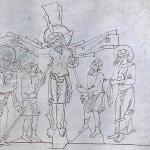
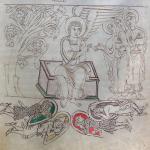
f. 31a. Full-page picture without frame, in two parts. Careful but unskilful drawing in outline.
Upper half. In C. Christ on tree-like cross (with wavy arms, knots, etc.). He has a cruciform nimbus which the limbs of the cross intersect. His loin-cloth reaches to the knees. He is attached to the cross by four nails. His head is inclined to L. On L. a small man in peaked cap stands on a small double mound and pierces Christ's side. On L. of him the Virgin nimbed holds her robe to her eye.
On R. a small bare-headed man offers the sponge on the reed: he too stands on a small double mound. On R. of him John, beardless nimbed, holds his R. hand to his face and supports his elbow with L. hand. The tree of the cross passes through a slit in the ground and twines into a tree in the lower picture.
Lower half. On L. a fine conventional tree.
In C. Angel seated full face on square tomb, he wears loose robe over tunic with embroidered collar. The tomb (shut) is heightened with purple and green colouring. The angel's wings both point to R. His R. hand is held out across his body towards the three women, nimbed, on L. on a little mound: two of them have caskets.
In the exergue four soldiers coarsely drawn, probably added later. They are prostrate, arranged in a half circle with their feet outwards, and recline on their kite-shaped shields. Two are mailed, the other two have tunics and peaked helmets: all have spurs and swords. The shields are coloured green, yellow, red and purple.
The initials are as follows:
Prologue, f. 2. Decorative, white on purple, green and blue.
Beatus uir. Three decorative initials.
Dominus illuminatio. „
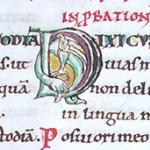
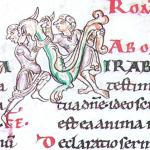
Dixi custodiam. Three initials with dragons.
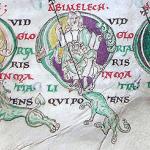
Quid gloriaris (86b). Three initials. a, b. Christ seated with book, piercing head of lion with long cross. c. Christ standing pierces head of human figure. Christ beardless throughout: the lion or human figure forms the tail of the Q. Grounds yellow and purple, and green and purple.
Dixit insipiens, Saluum me fac, Exultate, Cantate. Each has three decorative initials.
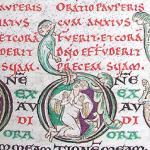
Exaudi deus. A kneeling suppliant in each: in the first the bust of Christ seen above.
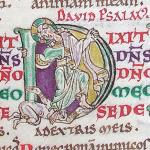
Dixit dominus. In the 2nd initial Christ treading on the head of a man.
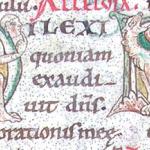
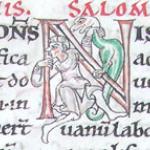
Dilexi quoniam. Man and dragon in 2nd and 3rd initials. Beati immaculati.
Decorative.
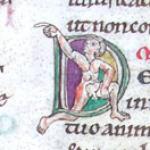
Defecit in salutari (166b). Two human figures, and a tailed man with hoof and clawed foot. Mirabilia. Men and dragons.
Ad dominum cum tribularer. Decorative.
Nisi dominus. Human figures, good.
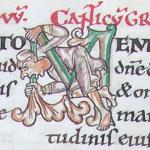
Confitebor (182). Fiddler and two dancers.
Confitebor (195). Isaiah nimbed, and woman.
The Rev. F. E. Warren considers that 'the execution of the drawings... and the forms and colouring of the initial letters, and the prayers for "regem nostrum" and "domnum archiepiscopum" on f. 212a indicate an English scribe and artist. It is an English copy of a French original' and 'probably belonged to and was written in one of the English cells of the French Abbey of S. Remigius at Rheims.' This might be Lapley in Staffordshire. The lands held by the Abbey in Northants, Stafford and Shropshire are indicated in Dugdale, Monast. vi (vii) 1099.
I do not agree with Mr Warren in thinking the style of the drawings, etc., English, but on the liturgical point I defer to his authority.
H. Besseler, Die Musik des Mittelalters und der Renaissance (Potsdam, 1931), p. 79.
F. A. Brockhaus ‘Die Musik im Denken des Mittelalters’, Eüropaische Musik in Schlaglichtern (1990), 77-8.
E. Buhle, Die musikalischen Instrumente in den Miniaturen des frühen Mittelalters: ein Beitrag zur Geschichte der Musikinstrumente. I. Die Blasinstrumente (Leipzig, 1903), passim.
W. Cahn, Romanesque manuscripts: the twelfth century (London, 1996), vol. I p. 22, ills. 157-9; vol. II no. 66.
F. Colin-Goguel, L’image de l’amour charnel au moyen âge (Paris, 2008) p.82 (reproduces and discusses f.1r).
M. M. Farquhar, ‘A catalogue of the illuminated manuscripts of the Romanesque period from Rheims’ (Univ. of London, Diss., 1968), pp. 111-13, 131-50, 274-85.
F. W. Galpin, Old English Instruments of Music (London, 1910), p. 218.
R. Hammerstein, Diabolus in Musica: Studien zur Ikonographie der Musik im Mittelalter (Bern and Munich, 1974), pp. 59-61.
A. Hughes (ed.), Early medieval music up to 1300 (London, 1954).
R. Kahsnitz, Der Werdener Psalter in Berlin, Ms. theol. Lat. fol. 358: eine Untersuchung zu Problemen mittelalterlichen Psalterillustration (Düsseldorf, 1979), pp. 157, 158, 185, 186-7, 228.
C. M. Kauffmann, Romanesque manuscripts 1066-1190 (London, 1975), p. 84.
G. Kinsky, Geschichte der musik in Biblem (Leipzig, 1929).
G. Kinsky, A history of music in pictures (London, 1930).
Musical Times (1904), f. 777.
I. Marchesin, L’image organum: la représentation de la musique dans les psautiers médiévaux 800-1200 (Turnhout, 2000), pp. 24, 26, 87, 89, 95-97, 244 (ill. 54).
E. Panofsky, Renaissance and Renascences in Western Art (Uppsala, 1965), pp. 92-3, n. 3.
H. de Sainte-Marie, Sancti Hieronymi Psalterium iuxta Hebreos (Collectanea Biblica Latina, XI) (Vatican, 1954), p. xli.
J-C. Schmitt, La raison des gestes dans l'Occident médiéval (Paris, 1990).
J. Smits van Waesberghe, Musikerziehung: Lehre und Theorie der Musik im Mittelalter (Leipzig, 1969), pp. 52-3.
T. Seebass, Musikdarstellung und Psalterillustration im früheren Mittelalter (Bern, 1973), pp. 40f., 94, 96, 121, 139, 153.
H. Steger, David Rex et Propheta (Nürnberg, 1961), p. 213, no. 38.
H. Swarzenski, Monuments of Romanesque art (London, 1954), pp. 60-1, no. 126.
L. von Wilckens, ‘Das Mittelalter und die Wilden Leute’, Münchner Jahrbuch der bildenden Kunst 45 (1994), 65-82.
Exhibited at Manchester, Romanesque Art, c. 1050-1200, 1959. See Catalogue pp. 21-2, no. 32.
Exhibited at Musée de la musique, Paris, Moyen Âge: entre ordre et désordre, 2004. See Catalogue no. 36.