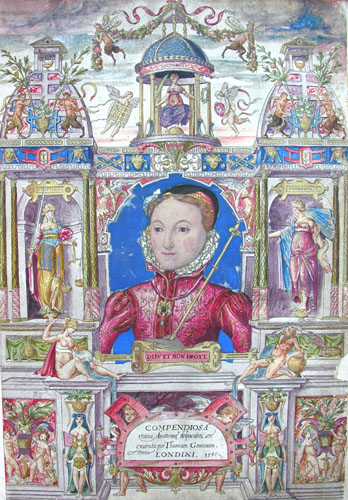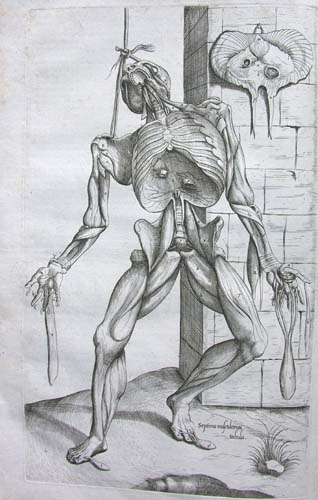
Thomas Geminus, Compendiosa totius anatomie delineatio (London, 1559)
Born in Belgium, Thomas Gemini came to London to work as an engraver, instrument maker and printer. His chief work was the Compendiosa, an illustrated work on anatomy which was a direct plagiarism of Andreas Vesalius's two great works on anatomy De fabrica humani corporis libri septem and Suorum de humani corporis fabrica librorum epitome, printed in 1543. Gemini engraved forty copper plates based on the woodcuts in Vesalius's works, copying the originals fairly closely but omitting the landscape/architectural backgrounds which appear in the woodcuts. It was Gemini's intention to present Vesalius's work in a more popular form, and in this he was highly successful - five editions claiming to be his Compendiosa were published in England between 1545 and 1559, of which the work illustrated is one. The text of the English editions, however, was not based on Gemini's plagiarism of Vesalius, although they bore his name, but were derived from the work of the French author Henri de Mondeville.
Vesalius, for one, was not flattered - in a letter of 1546 he attacked his 'incompetent imitators' for doing an injustice to the quality, anatomical and artistic, of his original blocks. But plagiarism and piracy were condoned in those days, when publications did not have the protection of modern copyright law. Whatever Vesalius's opinion, Gemini's engravings are considered to be the first copper engravings of importance to appear in an English book.
This first edition has a hand-painted frontispiece incorporating a portrait of a young Elizabeth I, although the fact that it does not resemble any other contemporary portraits may indicate that it was a hasty adaptation of one cut for Mary I. The Library also has a slightly later edition donated by Peter Gunning (Master 1661-1670), 1684.