PhD student Sarah Aguiar Monteiro Borges is working to transform the lives of young people suffering psychiatric illnesses in places lacking good access to mental health care.
Now the work of the 23-year-old Brazilian, who is in the first year of her doctoral studies in psychiatry at St John’s, has been spotlighted in the Forbes’ 30 Under 30 Brazil List for Science and Education, after distinguishing herself in research and student leadership.
Each year since 2011 the Forbes’ 30 under 30 lists have showcased notable young entrepreneurs, leaders, artists and other high-fliers who excel in their fields. Past honorees include Nobel Peace Prize winner Malala Yousafzai, Facebook founder Mark Zuckerberg, and Brazilian footballer Neymar. The Brazil list has been published since 2014 and has honoured more than 550 Brazilians.
“I have a real passion for science and education so it is a big honour and a surprise to be featured,” said Sarah. “As important as the research we do is communicating it to others.
“I hope by sharing our research we can help inform policymakers, clinicians, and people who have the means to affect real change.”
“In my research we have found that stigma is an important predictor of lower service use”
Globally, mental health conditions are the leading cause of disability among young people aged between 10 and 30, with 75 per cent of disorders emerging before 25. However, there is a large gap between the need for treatment and the supply of mental health services.
Brazil has more than 200 million people and in Sarah’s home city, Goiânia, there is just one psychiatric bed in the public health system for young people – for a population of 1.5 million.
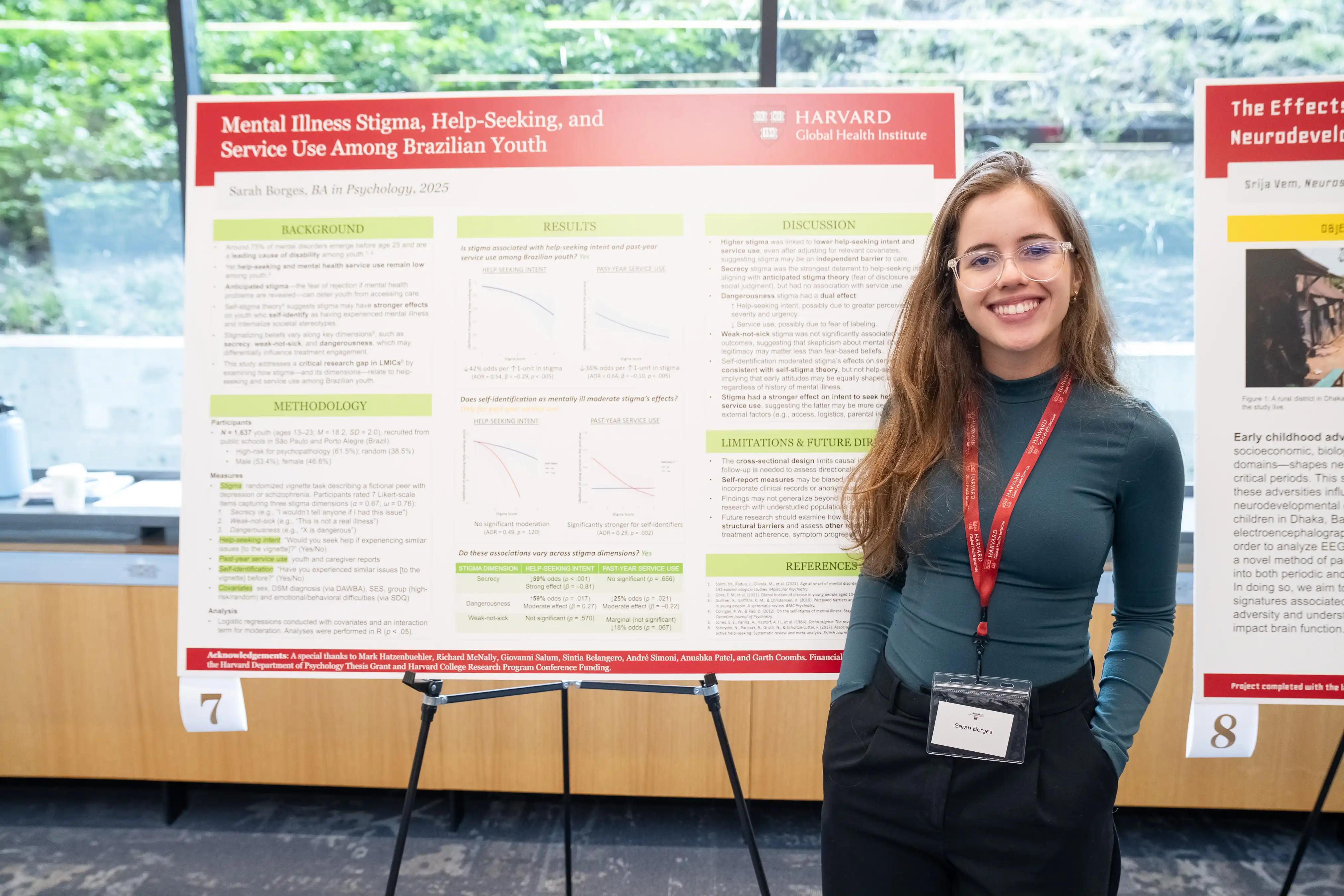
“Most people can’t even grasp the scale of the need,” said Sarah, who works with clinicians and researchers in Brazil. “In my research we have found that stigma, as in having negative beliefs about people with mental illness, is an important predictor of lower service use.
“I’m now looking at whether having stigma plays a role in whether someone can identify signs of mental illness in themselves, and if this explains their lower service use.”
She also explores the effectiveness of treatment. “In Brazil, as in most countries, the Ministry of Health has no systematic way of evaluating its mental health services. A goal of my research is to use existing data and causal inference techniques to get a good approximation of whether those services work, not only in Brazil but in places that need this knowledge to improve care.”
Sarah’s path to St John’s began as a medical student in Brazil. With her twin sister, Sophia, she had only shortly begun studying at the University of São Paulo when the Covid pandemic hit in March 2020 – and she learned she had won a full scholarship to Harvard.
After moving to the US, Sarah found ways to explore her interests and develop her passions, and worked in labs across Harvard, Oxford and Lancaster. “I soon realised psychology was the ideal bridge between my academic interests and love for scientific discovery,a nd I became especially interested in how social inequities intersect with health,” she said.
“My hope is that my research work can help us build more accessible, equitable, and effective mental health systems”
Sarah co-presided the Harvard Association for Democracy in the Americas, bringing the conference to Brazil for the first time in 30 years. She was also vice-president of the Brazil Conference – known as the ‘Brazilian Davos’ – where she co-created and led the researchers’ programme. This funded Brazilian researchers to present their work at the conference at Harvard and Massachusetts Institute of Technology.
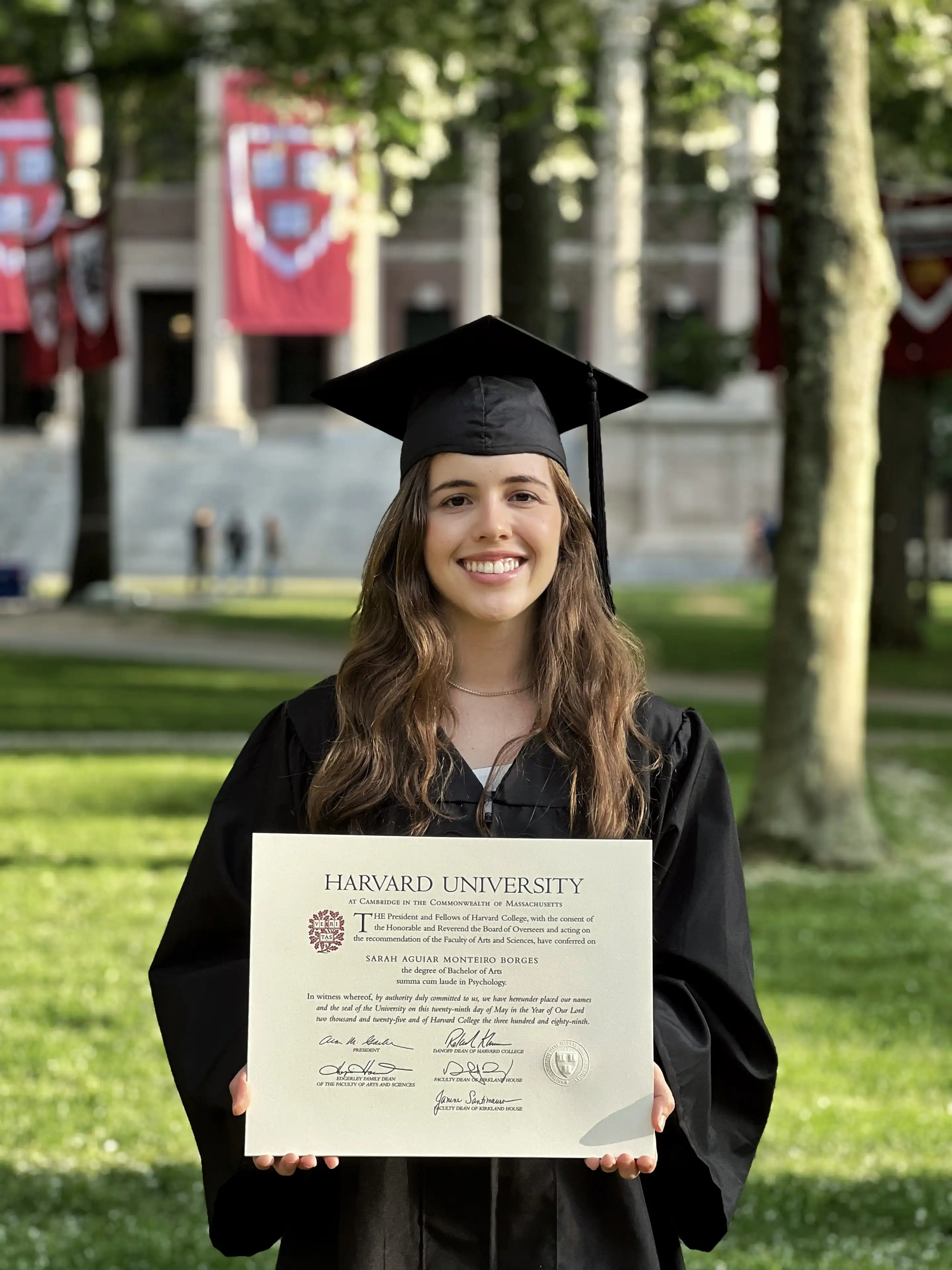
As an undergraduate she received many recognitions including election to Phi Beta Kappa, America’s most prestigious academic honour society. She was also the first Brazilian to be awarded Harvard’s Sophia Freund Prize after gaining the highest grade among nearly 2,000 graduates.
Sarah came to St John’s to continue her research after winning a Gates Cambridge Scholarship – an international postgraduate award for students to study at the University of Cambridge.
“My twin and I are the first in our close family to pursue a PhD, thanks to the support of scholarships from a young age. So it’s very meaningful to now be able to inspire other young people to pursue academic dreams that may seem out of reach," she added.
“My hope is that my research work can help us build more accessible, equitable, and effective mental health systems.”