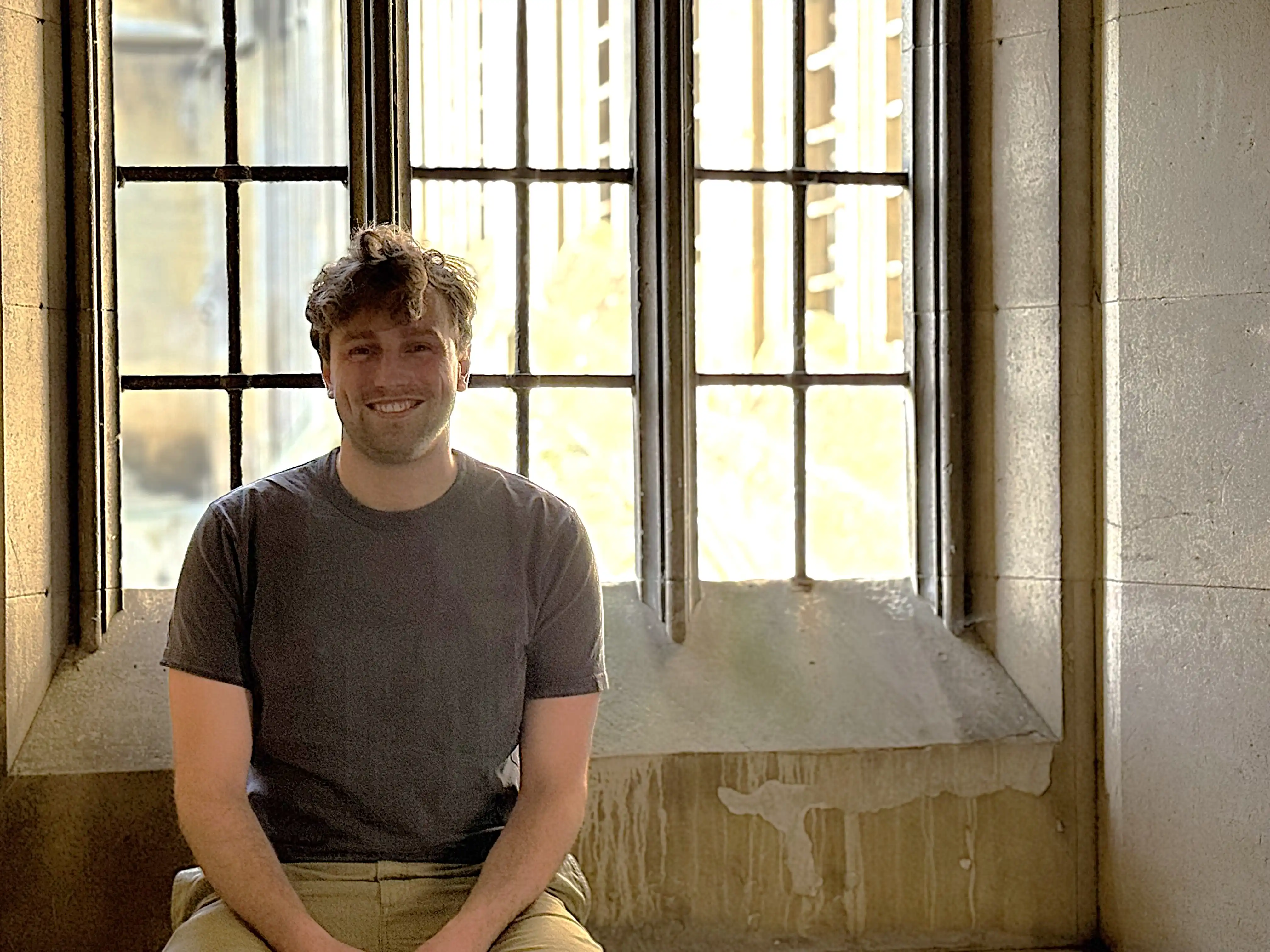
Charlie Colenutt had just completed training as a barrister in construction law when he resigned from his job to travel around the UK to ask 100 other people about theirs.
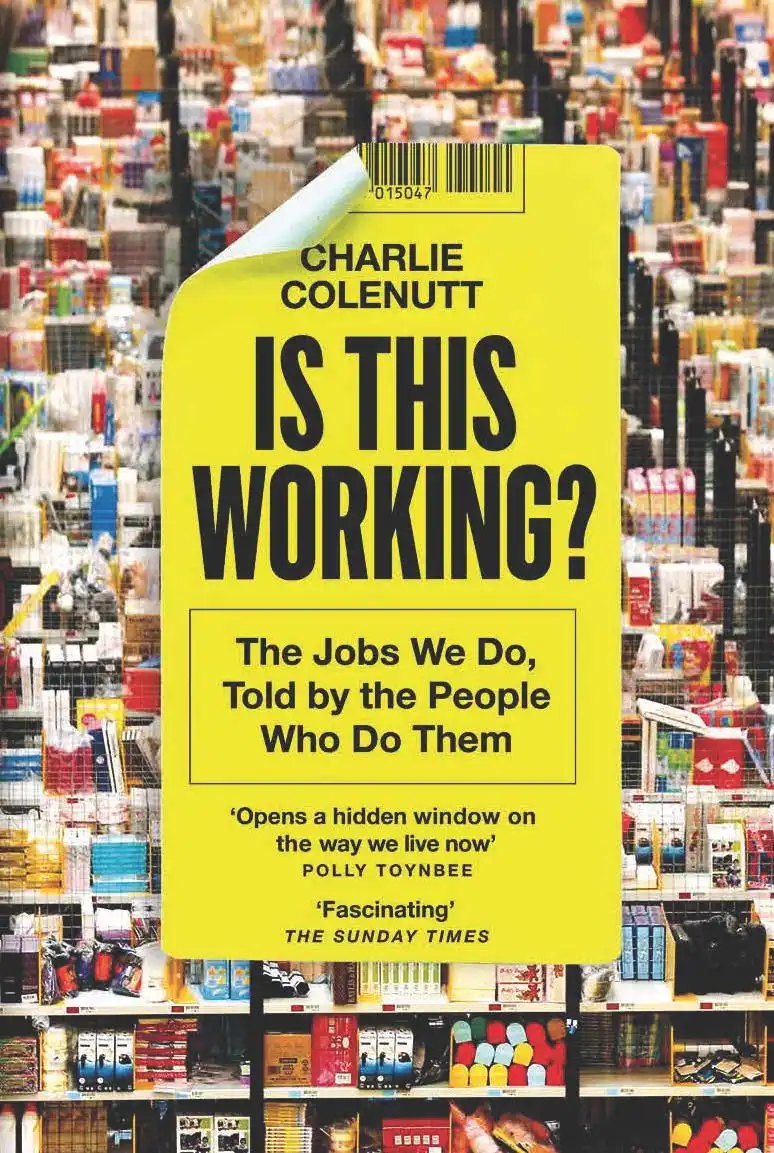
A midwife and policewoman, baker, teacher, and city trader all feature in his resulting non-fiction book, Is This Working? The Jobs We Do, Told by the People Who Do Them (Picador) – a snapshot of life and work in the British economy of the early 2020s.
Charlie, who is now in the first-year of a History PhD at St John’s, realised during the Covid pandemic that his first job after his degree at the University of Oxford wasn’t for him.
“After I started my pupillage, I knew pretty quickly that I’d made the wrong decision after I started my professional law training,” said Charlie. “I was working from an empty office for long hours, and I didn’t really enjoy the work.
“I felt I’d panicked when I decided to become a lawyer after my History degree, and then I didn’t really know what else I could do, or what else to do in life. I thought doing a book project like this would be quite a good way to find out.”
Charlie’s project was inspired by Studs Terkel, an American broadcaster and oral historian who in 1974 published a bestselling book called Working after interviewing more than 100 people about their jobs. These included a parking valet, a sanitation truck driver, a piano tuner, a lift operator, and a nun.
Subtitled People Talk About What They Do All Day and How They Feel About What They Do, it captured a snapshot of America in the 1970s and of the efforts, disappointments, and sometimes the pride of men and women workers across the USA.
“People aren’t used to talking about their jobs but most interviewees were very open. Everyone has a philosophy of life”
Picking up the baton where Terkel left off, Charlie finished his legal training, bought a van, and set off travelling around Britain for a year-and-a-half to speak to 100 strangers about their jobs – what they do, why they do it, and whether they like it.
“I thought it would be really interesting to do a similar project to Terkel’s 50 years on in the UK given that so much has changed since then. I was thinking of the decline of factory work, mining, and those types of industries,” said Charlie.
“Many of us now work in vague services jobs mediated by computers and I wanted to see if perceptions of work have changed.”
From his initial 100 interviews undertaken between 2021 and 2023, 68 people are featured anonymously in the book. They are from a diverse range of job sectors and demographics including different sexes, ethnicities,and immigration status.
“I set off around Britain with enough savings for a couple of months initially,” said Charlie. “Then I thought, I could put together a proposal to submit to publishers and if it didn’t go anywhere, I’d had a really good time talking to people, finding out about their work and lives, and seeing what matters to them.”
To find his subjects, he searched business directories and local social media groups, or wandered around a town stopping people in the street.
“When people tell you personal things you feel a weight of responsibility to portray them in as accurate and fair way as possible,” said Charlie. “People aren’t used to talking about their jobs but most interviewees were very open. Everyone has a philosophy of life.”
Charlie found that people who enjoyed their work most often had winding career paths and valued their tasks over their job titles. For many, life events – rather than any conscious plan – were the driving force for career change.
Some of the most content interviewees were those who had changed careers after some kind of crisis – illness, injury, or new caring responsibilities – and who had since found a freedom in accepting how little control they really had over the course of their working lives.
“One man I spoke to had hit rock bottom, doing various labouring jobs, working in factories, and was in a load of debt. He thought, ‘life can’t get any worse’. Then he started borrowing tools from friends and finding work as a joiner, and eventually he established his own business,” said Charlie.
“He was very happy with the balance he had found. Things had gone wrong for him before but it was okay, life had found a way.”
Another common theme he uncovered was a frustration with administrative tasks. Many interviewees found their day jobs so consumed by excessive paperwork that they had little time to do the work they enjoyed.
“It was really striking. Many workers find it suffocating. We spend so much of our working lives answering emails and writing up everything we’ve done that day that less time is spent on the actual work in front of us.”
For Charlie, the project highlighted the importance of gaining diverse work experience to understand the day-to-day aspects of different careers, such as the physical tasks involved, and the need for realistic expectations.
It also helped him clarify his own life goals. “It comes down to wanting a smaller life, outside of London, with more time to spend with my family. I realised that perhaps money isn’t enough of a compensation on that front.”
“Humans need to move, they need to feel like they’re doing some kind of skilled labour, that they have some autonomy, and that they’re respected”
While finishing his book, Charlie spread his own wings. He worked at a start-up and as a labourer on a building site before gaining his place at St John’s, with the aim of a career in academia.
“I always had in mind that I wanted to be a historian, and the book project clarified that I really enjoyed reading, research, writing, and teaching, and I was led back to my love of history,” said the father-of-two.
“I’d got a lot out of all the interviews I did with people in the construction sector and, having worked in construction law and then on building sites, I was fascinated by it as an industry. It was a natural step to pursue a career that combines all these things.”
In his PhD he studies multinational construction companies in the British and American empires, posing big questions about the emergence of global capitalism and empire.
“I have gone full circle where I’m now spending my days reading construction contracts again – except it’s for pleasure this time, and I love it,” said Charlie.
“I have a young family and the childcare support is excellent at St John’s, and there’s a really nice collegiate atmosphere and postgraduate community.”
Charlie hasn’t ruled out producing an update to his book in 10 years to reflect changes in the economy and workforce, including the impact of AI. “The book was written before AI products really became established, so in some ways it is the last picture of a world that is now ending,” he said.
He believes jobs such as construction trades and care work will become more attractive, offering ‘meaningful, productive and rewarding work’ that cannot be done by AI.
“Humans need to move, they need to feel like they’re doing some kind of skilled labour, that they have some autonomy, and that they’re respected.
“I suppose the book is, in part, a 400-page warning against thinking about work in abstract terms,” added Charlie. “It asks people to describe, in detail, what they actually do all day, and that is probably quite a good habit of mind when it comes to our own careers.
“The abstract questions we tend to ask ourselves – ‘What do I want to be?’, ‘Is this a good job?’, ‘Will I be important enough?’ – are much less useful than the more boring and concrete question of, ‘What specific tasks would I be content to spend 10 hours a day doing?’.”
· Published in hardback last year, Is This Working? The Jobs We Do, Told by the People Who Do Them (Picador) is now out in paperback, RRP £10.99.

The joiner “[I] don’t want a fleet of 10 vans. I don’t want to be on a million pounds a year. I don’t want to be any higher than I am. I’m happy. Everything’s balanced nicely, work, social life, family, gym, and still time for other things.
“I know that what balances can easily topple over, but if that happens, I’ll deal with it… Whatever is meant to happen is meant to happen. I try to let life run its course. I try not to mess around with it too much.”
The hospital matron “Things you once did routinely, without writing them down, now take five pages on a computer. Things that were once done because they made common sense now require a 10-page report.”
The gardener “There’s always the stress of what the weather is going to do, but on the other hand, you don’t have any targets, it’s not data-driven and you’re outside: the vitamin D helps with your mood; the soil, when you disrupt it, releases a bacteria that they’re now trialling as a medication for PTSD; and petrichor – the smell of rain after it’s been hot – signals that the fertile season is here and seems to produce a happy hormone in us. I don’t know anyone who doesn’t like that smell.
“I have a purpose in this world. To help people, help the planet, and to be outside. When I garden, I try to teach people that things don’t need to look perfect.”
The taxi driver “The taxi trade is like working in a bar. You meet every kind of person from every kind of background with every kind of story. Some of them are funny. Some of them are bad. Imagine being a fly on the wall. You hear conversations that you shouldn’t hear. You see things that you shouldn’t have seen. It’s a rewarding job. It’s a job where everything’s live.”