Thomas More's Utopia (1516) and Epigrammata (1520)
Knighted in 1521, More rose to become Lord Chancellor before being executed for high treason in 1535. He is a saint to the Catholic and a predecessor of Marx to the Communist.
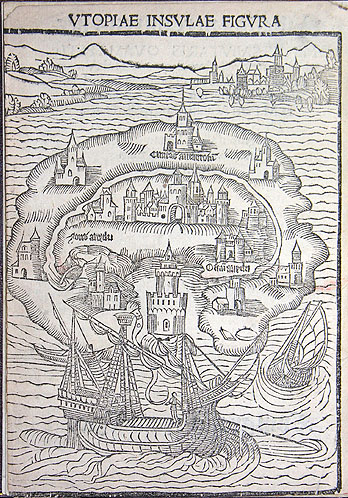
Written in Latin for a European audience, More's Utopia is the quintessential humanist dialogue. First published in Louvain, Belgium, in 1516, Utopia was an immediate sensation. Set as a dialogue in Antwerp between More and a voyager returned from newly discovered lands, the complexity of the work ensured that it would have nearly as many interpretations as readers. Utopia broadly satirises European society for its short-sighted love of gain, its lack of Christian piety and charity, and its unreasonableness, and attacks injustices in the English criminal code. But More's 'Utopia' (pictured below in the woodcut map from this edition) is not an ideal state, as the word has since come to mean.
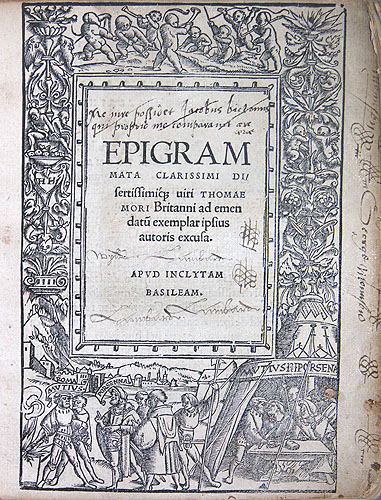
The first complete and separately issued edition of More's Latin and Greek epigrams was published by John Froben in Basel in 1520, from manuscripts collected by Erasmus (title page reproduced below). Many of More's epigrams explore the problems of tyranny, and reveal his profound unease with the corruption often associated with kingship.
The Old Library is especially fortunate to have recently acquired these two Thomas More first editions, owing to the generosity of Brian Fenwick-Smith (BA 1959).