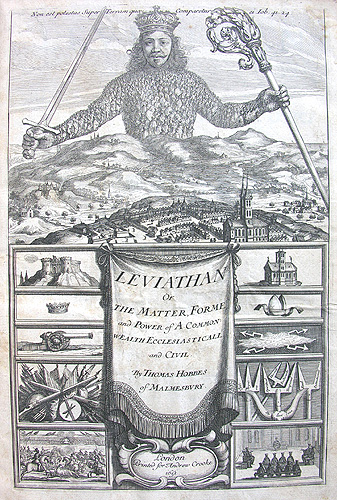
Thomas Hobbes, Leviathan (London: Andrew Crooke, 1651).
The frontispiece to a work could act as a guide to the subject matter and argument of a volume, and the best might achieve a succinctness and impact that the text itself might lack. That to Thomas Hobbes’s major work on political theory is a prime example. Whilst the text itself attempts to find a rational grounding for the authority of the state, relying on the desire of the people to avoid an anarchic natural condition in which life is “nasty, brutish and short”, the introductory image is just as memorable. It depicts a monarchical figure whose body is created from a multitude of smaller figures. It was produced by Abraham Bosse, an engraver of French origins, although Hobbes had input into its design. Like all good icons it has been appropriated and re-envisaged on numerous occasions.